
Get directions
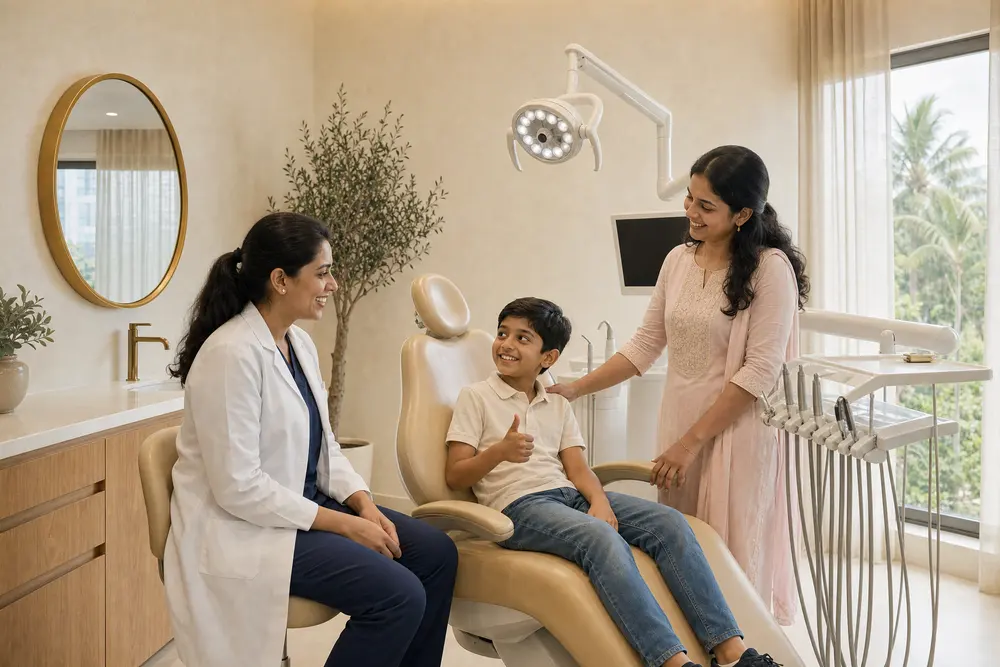
Dentistry for children
Check-ups, fluoride and fillings for milk teeth, from a child's first visit onwards.
You may know this as pallu doctor.
- Where
- First floor, Potta, on NH 544
Get directions - Open
- Every day, 10 am – 7 pm
- Who treats you
- Dr. Pavya Priya · KDC 28861
- Fees
- 1 fee range
See all fees
On this page
Children are seen at Kallada Smile by Dr. Pavya Priya, a registered dentist. The aim of the early visits is simple. Find problems while they are small, and let the child get used to the chair before anything has to be done.
You may know the dentist as the pallu doctor.
What it is
A first visit is recommended by the first birthday, or within six months of the first tooth appearing. It takes a few minutes: a look, a count, and advice on brushing and bottle habits.
Nothing is done to a small child at that visit unless something needs doing. The point is that the first time in a dental chair is not the day a tooth hurts.
Children’s dentistry then covers check-ups, cleaning, fluoride, fillings in milk teeth and sealants. It also covers habits such as thumb sucking, and knocks to the front teeth.
Signs you might need it
- Your child has never been to a dentist, and is over one year old.
- A white, brown or black mark on a tooth.
- A hole you can see, or food packing in the same place.
- Complaints of pain with sweet or cold things, or at night.
- A swollen gum or face, which needs seeing the same working day.
- A tooth broken or knocked in a fall.
- A milk tooth that will not come out while the adult tooth is coming up behind it.
- Thumb sucking or mouth breathing that continues after the adult front teeth arrive.
- Teeth that look crowded or crooked as the adult ones come through.
Six-monthly visits without symptoms are the point of the exercise, not the exception.
What happens at Kallada Smile
Settling in. The child sits in the chair and sees the light and the small mirror. Each thing is named before it is used.
Counting and examining. Dr. Pavya counts the teeth aloud, checks each one, and looks at the bite and the gums. Parents stay in the room.
Cleaning. A gentle polish where there is deposit. Most young children need nothing more.
Fluoride varnish. Painted on quickly, where it is useful. It tastes of the flavour chosen and sets on contact.
Advice, to the parent and the child. Brushing technique, how much toothpaste, what to put in the bottle, and which snacks matter most. Short and specific, not a lecture.
A plan, if anything is needed. Written, with the fee range for each item and how many visits it will take. Treatment is spread over short visits rather than crammed into one.
Options
Check-up and advice only. For many children this is all that is needed.
Cleaning and fluoride varnish. Where deposit has built up or the child is at higher risk of decay.
Fissure sealant. A coating that closes the deep grooves of the first adult molars. No drilling, no injection.
Filling in a milk tooth. Often in glass ionomer, which releases fluoride and takes little time to place.
Pulp treatment in a milk tooth. Where decay has reached the nerve but the tooth is still worth keeping. It is followed by a metal cap in most cases.
Removing a milk tooth. Where the tooth cannot be saved. A space maintainer may follow, so the adult tooth keeps its room.
Referral. Very young children needing extensive treatment may be referred for treatment under sedation or anaesthesia. So may children who cannot manage in the chair. Dr. Pavya will say so plainly rather than force a visit.
What can go wrong
A numbed lip or cheek feels strange to a child and is easy to bite without feeling it, so a child is watched until the numbness wears off. A filling in a milk tooth can come out, and decay can start again beside it. Pulp treatment in a milk tooth does not always hold, and the tooth is then removed. A metal cap looks like metal, and parents are shown one before it is agreed. Removing a milk tooth early can let the neighbouring teeth drift into the space, which is why a space maintainer is sometimes fitted. A first visit that goes badly costs the next one, so nothing is forced and no promise is made about how it will feel.
How long it takes and how many visits
A child’s check-up takes 15 to 30 minutes. A sealant adds 10 minutes per tooth.
A filling in a milk tooth takes 20 to 30 minutes. Where several are needed, they are usually spread over 2 to 4 short visits, so no appointment outlasts the child’s patience.
Routine visits are every six months for most children, and more often where decay has been active.
Come at a time of day when the child is rested. Morning appointments usually go better than late-afternoon ones.
Looking after it afterwards
- Brush twice a day, and do the brushing yourself until about age seven. Small hands cannot reach the back teeth properly.
- Use a smear of toothpaste under three and a pea-sized amount from three to six. Encourage spitting, not rinsing.
- Nothing but water in the bottle at night, and move to a cup from about age one.
- Sweets with a meal do less harm than sweets between meals. It is how often, not how much.
- After a fluoride varnish, avoid hard or hot food for the rest of the day.
- Never tell a child that a visit will not hurt. Say that Dr. Pavya will explain everything first and stop if they raise a hand.
- If a front tooth is knocked out, look at which tooth it is. A milk tooth is never put back. An adult tooth should be put back into its socket at once, held by the white crown and never by the root, rinsed for a few seconds in milk or cold water if it is dirty, never scrubbed and never allowed to dry; bite on a clean handkerchief to hold it and come the same day. If it cannot be put back, keep it in milk or in the child’s own saliva and get to a dentist within the hour. At night or on a Sunday, take the tooth and go to a hospital casualty department.
Fees
- Child's check-up and cleaning₹300 – ₹1,000
The final fee is confirmed after examination, in writing, before treatment starts. See all fees
Questions about dentistry for children
Do milk teeth need filling if they will fall out anyway?
Yes, in most cases. A back milk tooth stays until about age eleven. A cavity at five has years to reach the nerve and cause a swelling. Milk teeth also hold the space for the adult tooth behind them; losing one early lets the neighbours drift in. Dr. Pavya says which teeth are close enough to falling out to be left.
How much toothpaste should a small child use?
A smear the size of a grain of rice under three. A pea-sized amount from three to six. An adult does or finishes the brushing until about seven. Encourage spitting rather than rinsing, so a little fluoride stays on the teeth.
What is bottle decay?
Decay on the upper front teeth of a toddler. It is caused by milk, juice or sweetened water sitting against the teeth for long periods. Often from a bottle at night. It moves quickly because milk-tooth enamel is thin. Water in the bottle at night, and a cup rather than a bottle from about one, are what prevent it.
How do we prepare a nervous child for a first appointment?
Keep it plain and short. Say a dentist will count the teeth. Avoid the words that carry fear, including any promise that nothing will hurt. A promise you cannot keep costs you the next visit. Come at a time when the child is rested. Sit where they can see you, and let Dr. Pavya do the talking to the child.
Are sealants worth doing?
Often, on the deep grooves of the first adult molars that arrive around age six. The groove is narrower than a bristle, so it cannot be brushed clean, and a sealant closes it. It takes a few minutes, needs no injection and no drilling, and it is checked at each visit.
Care for every smile
Ready when you are.
Tell us your name and what is bothering you. We reply with a time.