
Get directions
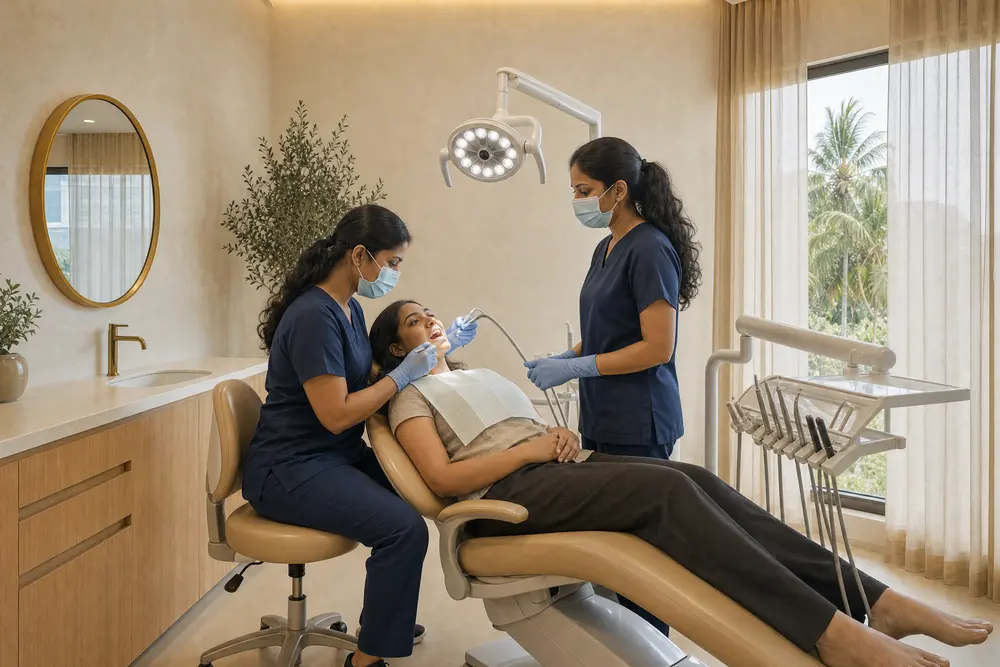
Root canal treatment
Removes the infected nerve inside a tooth and saves the tooth instead of taking it out.
- Where
- First floor, Potta, on NH 544
Get directions - Open
- Every day, 10 am – 7 pm
- Who treats you
- Dr. Pavya Priya · KDC 28861
- Fees
- 1 fee range
See all fees
On this page
A root canal treats a tooth whose nerve is infected. It clears the infection from inside the tooth and saves it, instead of removing it. At Kallada Smile, root canals are done by Dr. Pavya Priya, a registered dentist.
What it is
Inside every tooth is a soft core of nerve and blood vessels, called the pulp. Deep decay, a crack or a heavy knock lets bacteria reach it. The pulp becomes inflamed, then dies, and infection spreads out of the root tip into the bone.
Root canal treatment (RCT) removes that tissue. Fine instruments clean and shape each canal, a disinfectant washes it, and the space is sealed so bacteria cannot return.
The tooth stays in the jaw and keeps working. What it loses is its nerve supply, so it no longer feels hot and cold. A treated tooth also has less tooth substance left, which is why a crown usually follows on a back tooth.
Signs you might need it
- Throbbing pain that keeps you awake, or that is worse when you lie down.
- Pain with hot food or drink that lingers after the food is gone.
- A tooth that hurts when you bite on it, or when you tap it.
- Swelling of the gum near a tooth, or a small pimple on the gum that comes and goes.
- A tooth that has darkened compared with its neighbours.
- A deep cavity or a lost filling in a tooth that has since started aching.
- Pain that stopped on its own after being severe.
A tooth can also need a root canal with no pain at all, found on an X-ray.
What happens at Kallada Smile
Examination and X-ray. Dr. Pavya tests the tooth with cold and presses it. An X-ray is then needed to show the canals and the bone around the root tip. X-rays are not taken at Kallada Smile: the clinic does not hold a radiation licence yet. Where one is needed you are given a written note and sent to a radiology centre in Chalakudy, about five minutes away by road, which charges you separately. The picture is read and explained at your appointment.
The plan and the fee. You are told how many visits are likely, and whether a crown will be needed afterwards. The fee range for the whole course comes with it. You decide.
Numbing and isolating. The tooth is numbed, then isolated with a rubber sheet so nothing from the mouth enters the canals.
Cleaning the canals. An opening is made through the biting surface of the tooth. The infected tissue is removed from each canal with fine instruments, and the canals are washed with a disinfectant.
Dressing or sealing. If the infection is active, a medicated dressing is placed and the tooth is closed until the next visit. When the canals are quiet, they are sealed with a rubber-like material.
Restoring. The opening is filled, and a crown is fitted on most back teeth. Until it is, chew on the other side.
Options
Root canal, then a crown. The usual plan for a back tooth. The tooth is kept and protected.
Root canal, then a filling. Sometimes enough for a front tooth with plenty of sound structure left.
Dressing first, treatment later. Where a swelling has to settle before the canals can be cleaned properly.
Retreatment. Where a root canal done earlier has failed and the tooth is worth saving again. It takes longer than a first treatment.
Removing the tooth. Chosen where the tooth is broken below the gum, the root is cracked, or you would rather not go through the treatment. A gap then needs planning for.
Referral. A tooth with unusually curved or blocked canals may be referred. Kallada Smile does not have a visiting root canal consultant yet. We would send you to a nearby clinic, and tell you the likely fee first.
What can go wrong
A canal can be blocked, unusually curved or hard to find. An instrument can separate inside a canal, or make a small opening through the side of the root, and either can change the plan for the tooth. The tooth can flare up and ache for a few days after a visit, and a swelling can appear. Some treated teeth do not settle: those need the treatment done again, a small operation at the root tip, or removal. No outcome can be promised in advance, which is why the bone around the root is checked on a review picture.
How long it takes and how many visits
Most root canals take 1 to 3 visits, each of 45 to 90 minutes. A front tooth with one canal takes least; a molar with three or four takes most.
Where a crown follows, add 2 more visits about a week apart, and allow 1 to 2 weeks between the impression and the fitting.
Aching for two or three days after each visit is common, and paracetamol taken as the packet says usually settles it. Do not start an antibiotic you have at home. Pain that grows, or a swelling that appears, should be reported the same working day.
Looking after it afterwards
- Chew on the other side until the tooth has its final filling or crown. An unprotected treated tooth splits easily.
- Take any medicine exactly as prescribed, and finish an antibiotic course if one was given.
- Do not delay the crown. A treated tooth left without one can crack, and that is a common reason treated teeth are lost.
- Keep the temporary filling in place. If it comes out, message us; the canals are open to infection until it is replaced.
- Clean the tooth normally, including between the teeth. A treated tooth can still decay at the edges.
- Come for the review X-ray when it is due, so the bone around the root can be checked as it heals.
Fees
- Root canal treatment, per tooth₹3,500 – ₹6,500
The final fee is confirmed after examination, in writing, before treatment starts. See all fees
Questions about root canal treatment
Does a root canal hurt while it is being done?
The tooth is numbed before anything starts. The treatment itself feels like having a long filling: pressure, and the sound of the instruments. A tooth with a live infection can be harder to numb. Dr. Pavya may need extra anaesthetic, or may settle the infection first. Tell us if you feel anything and we stop.
Does a tooth always need a crown after a root canal?
Back teeth almost always do, because so much tooth has been removed that the remaining walls split under chewing. Front teeth sometimes manage with a filling. Dr. Pavya tells you which applies before the root canal starts. The crown fee is then part of the plan, and not a surprise later.
Can a root canal be finished in one visit?
Sometimes, for a straightforward front tooth without active infection. Molars have more canals. A tooth with pus around the root is usually dressed and left for a week or two, so the infection settles. Dr. Pavya says at the first visit how many appointments your tooth is likely to need.
How long does a root-canal-treated tooth last?
Many last for years once they are sealed and crowned. A treated tooth is checked at every routine visit, like any other. What shortens it is a delayed crown, a cracked root or new decay at the edge of the filling. No outcome can be promised in advance.
What if I choose to have the tooth removed instead?
That is a fair choice, and it costs less on the day. It leaves a gap, and the teeth on either side drift into it over the years. A bridge, a denture or a referral for an implant usually follows. Dr. Pavya gives you the fee range for both routes and you decide.
Care for every smile
Ready when you are.
Tell us your name and what is bothering you. We reply with a time.