
Get directions
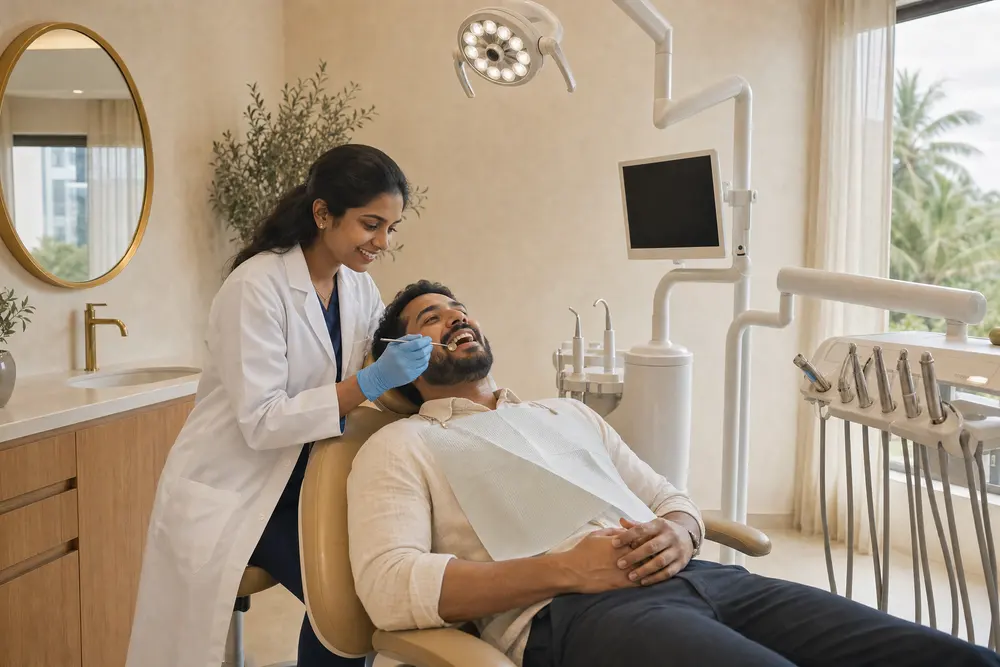
Check-up and cleaning
An examination of every tooth and gum, with scaling to remove hardened plaque.
You may know this as pallu doctor.
- Where
- First floor, Potta, on NH 544
Get directions - Open
- Every day, 10 am – 7 pm
- Who treats you
- Dr. Pavya Priya · KDC 28861
- Fees
- 2 fee ranges
See all fees
On this page
A check-up is a look at every tooth, the gums and the soft tissues of the mouth. A cleaning removes what a toothbrush cannot. At Kallada Smile both are done by Dr. Pavya Priya, a registered dentist.
You may know the dentist as the pallu doctor.
What it is
Plaque is the soft film that forms on teeth within hours of brushing. Left alone it hardens into tartar, which a brush cannot shift. Tartar holds more plaque against the gum, and the gum becomes inflamed.
Cleaning (scaling) removes that hardened deposit with an ultrasonic scaler. The tip vibrates rapidly and a water spray washes the debris away. The scaler removes the deposit, not the tooth.
Polishing follows, which smooths the surfaces so plaque takes longer to stick again.
The examination is the more important half. It finds decay, cracks, worn fillings, gum pockets and anything unusual in the soft tissues, while each is still small.
Signs you might need it
- It has been six months or more since your last check-up.
- Your gums bleed when you brush.
- You can see or feel a hard, rough deposit near the gum line.
- Your breath is bad even after brushing.
- Food packs into the same gap after every meal.
- A tooth is sensitive to cold, or a spot on a tooth has changed colour.
- You are about to start braces, a crown or any other planned treatment.
These are easier to deal with early, and none of them is a reason to worry.
Get these looked at promptly, whether or not anything hurts
- An ulcer or a sore patch in the mouth that has not healed in three weeks.
- A white or a red patch on the tongue, the cheek, the gum or the palate.
- A lump or a hard swelling in the mouth, the lip or the neck.
- Numbness anywhere in the mouth, the lip or the tongue with no cause.
- A tooth that has become loose with no decay and no gum disease to explain it.
- Difficulty opening the mouth, swallowing or moving the tongue that does not settle.
Smoking, chewing paan, gutkha or tobacco in any form, and heavy drinking are what make these more likely, and Kerala has more mouth cancer than anywhere else in India. Most of these turn out to be harmless. The reason to come early is that the ones that are not are far easier to treat when they are small. The check-up includes a look at the tongue, the cheeks, the floor of the mouth and the palate for exactly this reason.
What happens at Kallada Smile
Talking first. Dr. Pavya asks what you have noticed, what medicines you take, and whether anything hurts.
Examination. Every tooth is checked, then the gums are measured where they look inflamed, then the tongue, cheeks and palate.
X-ray, only if needed. Most check-ups need none. X-rays are not taken at Kallada Smile: the clinic does not hold a radiation licence yet. Where one is needed you are given a written note and sent to a radiology centre in Chalakudy, about five minutes away by road, which charges you separately. The picture is read and explained at your appointment.
Cleaning. The scaler works around each tooth, above the gum line and just below it. You feel vibration and cold water. If the gums are sore, the area can be numbed first. Tell us and we stop whenever you raise a hand.
Polishing and varnish. The teeth are polished, and a fluoride varnish is painted on where it is useful.
A written note. You leave with what was found, what needs doing, the fee range for each item, and a date for the next check-up. You decide what to do and when.
Options
Check-up alone. An examination and a written note, without cleaning. Sometimes all that is needed.
Cleaning above the gum line. The routine cleaning, both jaws, in one visit.
Deep cleaning below the gum line. Where the gum has pulled away and tartar sits under it. Usually done with the area numbed, sometimes across two visits, and it belongs with gum treatment rather than a routine clean.
Fluoride varnish. A coat painted onto the teeth after polishing. Useful for children, for people with many fillings, and for anyone whose teeth are sensitive.
Stain removal with an air polisher.
What can go wrong
Cleaning is the gentlest treatment in the clinic and it still has effects worth knowing about. Teeth can be sensitive to cold for a day or two, and longer where the gums were badly inflamed. Where heavy tartar was holding inflamed gum in place, the gum shrinks back once it is removed, so gaps can appear between the teeth and the necks of the teeth can show. Gums usually bleed during a cleaning and for a day or so afterwards, which matters if you take a blood thinner: tell us before it starts. None of this is a reason to leave tartar where it is.
How long it takes and how many visits
A check-up and a routine cleaning together take 30 to 45 minutes in one visit.
Heavy tartar, or a mouth that has not been cleaned for years, may need two visits. One visit for each half of the mouth keeps any single appointment short.
Deep cleaning below the gum line is quoted separately and usually runs to 1 to 3 visits.
Most people come back every six months. Dr. Pavya sets your interval after seeing how quickly deposit forms.
Looking after it afterwards
- Teeth can feel sensitive to cold for a day or two, especially where the gums were inflamed. It settles.
- If a fluoride varnish was applied, avoid hard or hot food for the rest of the day.
- Brush twice a day for two minutes with a soft brush, at the angle Dr. Pavya shows you. Pressure is not what cleans; the angle is.
- Clean between the teeth once a day with floss or an interdental brush. A brush cannot reach the surfaces where decay usually starts.
- Gums that bleed at first usually stop within one to two weeks of proper brushing. If they are still bleeding after that, come back.
- Rinse with plain water after tea, coffee or paan rather than brushing at once.
Fees
- Consultation₹300
- Cleaning (scaling and polishing), both jaws₹800 – ₹1,500
The final fee is confirmed after examination, in writing, before treatment starts. See all fees
Questions about check-up and cleaning
How often is a cleaning needed?
Every six months suits most people, and once a year is enough for some. People who smoke, who have diabetes, who wear braces or who form tartar quickly are usually seen more often. Dr. Pavya tells you the interval that fits your mouth rather than a standard one.
Does scaling loosen the teeth?
No. Tartar does not hold teeth in; bone and fibres do. Where a lot of tartar is removed from around loose teeth, they can feel different for a week or two. The packing has gone. If they were already loose, that was gum disease, not the cleaning.
Will a cleaning make my teeth whiter?
It removes stain from tea, coffee, tobacco and paan, so teeth often look lighter afterwards. That is the natural colour of the tooth coming back, not a change to it. Cleaning cannot lighten a tooth beyond its own shade; that is a separate treatment with its own fee.
Why do gums bleed during a cleaning?
Bleeding means the gum is already inflamed by the tartar sitting against it. Cleaning removes the cause, and the bleeding usually settles within one to two weeks of brushing properly. Gums that keep bleeding after that need a closer look.
Is an X-ray part of a routine check-up?
Not usually. Most check-ups need no X-ray at all. One is taken when there is a symptom, or when decay is suspected between the teeth. A root canal or a wisdom tooth usually needs one too. We tell you before, and why. X-rays are not taken here: the clinic holds no radiation licence yet, so you are sent to a radiology centre in Chalakudy, about five minutes away by road, which charges you separately.
Care for every smile
Ready when you are.
Tell us your name and what is bothering you. We reply with a time.