
Get directions
Teeth whitening
Lightening the natural shade of the teeth, in the clinic or with a home kit.
- Where
- First floor, Potta, on NH 544
Get directions - Open
- Every day, 10 am – 7 pm
- Who treats you
- Dr. Pavya Priya · KDC 28861
- Fees
- 1 fee range
See all fees
On this page
Whitening lightens the natural shade of the teeth using a peroxide gel. It is a cosmetic treatment: it changes colour, and nothing else. At Kallada Smile it is done by Dr. Pavya Priya, a registered dentist.
What it is
Tooth colour comes from two places. Surface stain from tea, coffee, tobacco and paan sits on the outside, and a cleaning removes it. The deeper shade comes from the dentine under the enamel, and only whitening changes that.
The gel releases oxygen, which breaks down the coloured molecules held inside the tooth. The tooth structure itself is not removed or reshaped.
Whitening (tooth bleaching) works on natural tooth only. Crowns, veneers and tooth-coloured fillings stay exactly the shade they were made in.
Signs you might need it
- Teeth that have darkened gradually with age.
- Stain from years of tea, coffee, tobacco or paan that a cleaning has not fully lifted.
- A yellow shade that has always bothered you in photographs.
- One tooth darker than its neighbours after a knock or a root canal.
- An event coming up, with enough time to do this without rushing.
Whitening is never medically necessary. It is entirely your decision, and it is reasonable to decide against it.
What happens at Kallada Smile
Check-up first. Decay, a leaking filling or inflamed gums are treated before any gel goes near the teeth. Gel on an untreated cavity hurts.
Cleaning. Surface stain is removed first, so the gel acts on the tooth and not on the deposit. Sometimes the cleaning alone is enough, and Dr. Pavya will say so.
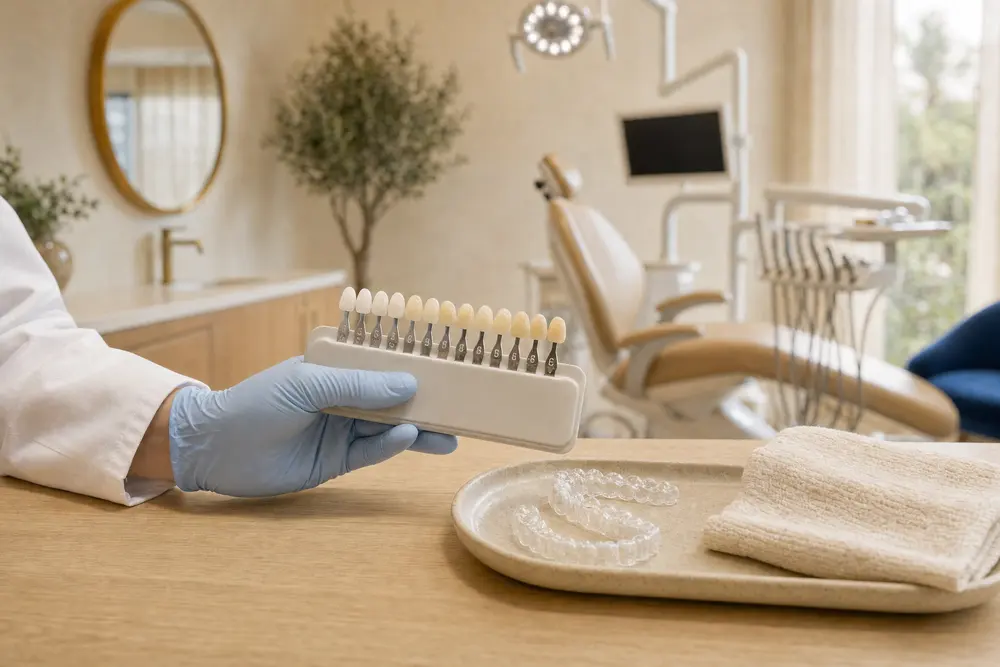
Shade record. The starting shade is matched against a guide and noted, so the change can be judged honestly afterwards rather than from memory.
In the clinic. The gums and lips are covered with a protective barrier. The gel is applied to the front teeth for timed periods, and rinsed between them.
Or at home. Impressions are taken and thin trays are made to fit your teeth. You are given the gel, shown how much to use, and told how long to wear the trays each day.
Review. The shade is recorded again, and any sensitivity is discussed. More gel for the trays is charged separately from the course, and the figure is on the fees page.
Options
In the clinic. One appointment, a stronger gel, done under supervision. It suits people who want it finished in a single visit.
At home with fitted trays. A lower-strength gel worn for a set time each day over about two weeks. Slower, gentler on sensitive teeth, and the trays can be reused for a repeat course later.
Both. A clinic session followed by trays for maintenance.
Whitening a single dark tooth. A root-canal-treated tooth can sometimes be lightened from the inside, over a few visits. It is a different procedure with its own fee.
Doing nothing. Always an option, and often the right one where the shade is even and the teeth are sound.
Something else entirely. Where the colour comes from a large old filling, from fluorosis patches, or from tetracycline banding, whitening will not deal with it. Dr. Pavya will tell you plainly if whitening will not help.
What can go wrong
Whitening makes teeth sensitive to cold for a day or two in most people, and longer in a few; the gums can be irritated where gel touches them. It does not lighten a crown, a filling or a veneer, so work at the front of the mouth can end up a different shade from the teeth beside it and may need replacing to match. The shade reached cannot be promised in advance and it fades. Whitening a root-treated tooth from the inside can, rarely, start the root dissolving from the outside at the neck of the tooth, which is why the tooth is checked before and afterwards. It is not done on untreated decay, exposed dentine or inflamed gums, and it is not done for children, or during pregnancy or breastfeeding.
How long it takes and how many visits
A clinic session takes 60 to 90 minutes, including the preparation, in one visit.
A home kit takes one visit to make the trays, then about two weeks of daily wear, then a short review.
Any check-up, cleaning or fillings needed first come before that and are quoted separately.
How much lighter the teeth go varies from person to person, and it cannot be promised in advance. Yellowish teeth generally respond better than greyish ones.
Looking after it afterwards
- Avoid tea, coffee, cola, red-coloured curries, beetroot and paan for the first 48 hours. The teeth take up stain most easily just after treatment.
- Do not smoke during the course or for the days after it.
- Use a toothpaste for sensitive teeth for a week if cold bothers you. Sensitivity usually settles in one to three days.
- Rinse with water after staining food and drink, and wait before brushing.
- Keep the trays clean and dry, in their case, if you plan a repeat course later.
- Have a cleaning appointment every six months. Most of the fading people notice is surface stain returning, not the whitening wearing off.
- Do not buy stronger gel online to speed it up. Strength is what causes gum burns, not slowness.
Fees
- Teeth whitening₹6,000 – ₹12,000
The final fee is confirmed after examination, in writing, before treatment starts. See all fees
Questions about teeth whitening
How long does whitening last?
Commonly one to three years. It is less for people who drink several teas or coffees a day, who smoke, or who chew paan. The shade fades slowly rather than reversing overnight. A short repeat course with a home kit is the usual way to hold it. That needs trays Dr. Pavya has made for you.
Will whitening lighten a crown or a filling?
No. Whitening works on natural tooth substance only. Crowns, veneers and tooth-coloured fillings keep the shade they were made in. If a front tooth has a large filling, whitening the teeth around it can leave that filling looking darker. It may then need replacing to match. Dr. Pavya points this out before you start.
Is whitening safe for the enamel?
Used at the strengths a dentist supplies and for the time set, it does not soften enamel in any lasting way. What it does cause is temporary sensitivity. The risks come from unsupervised kits at unknown strengths, and from gel sitting on the gum. That is why the gums are protected and trays are made to fit.
Why do teeth feel sensitive after whitening?
The gel opens the tiny channels that run through the tooth, so cold reaches the nerve more easily for a while. It usually settles within one to three days. A sensitive toothpaste, and shorter sessions, both help. Tell Dr. Pavya if it happened last time and the plan is adjusted.
Do whitening toothpastes work?
They remove surface stain by being slightly abrasive, so teeth can look cleaner. They do not change the natural shade of the tooth, because they are not on the tooth long enough to do so. A cleaning appointment does the same job more thoroughly and without wearing the enamel.
Care for every smile
Ready when you are.
Tell us your name and what is bothering you. We reply with a time.