
Get directions
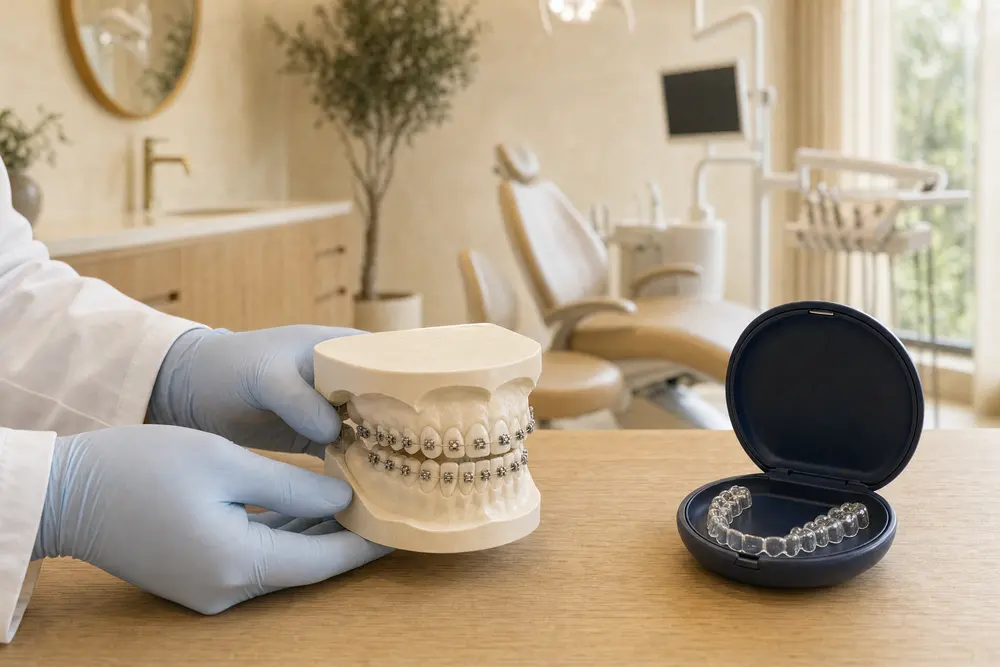
Braces
Small brackets and a thin wire that move crowded, gapped or protruding teeth into place over months.
You may know this as pallu kambi.
- Where
- First floor, Potta, on NH 544
Get directions - Open
- Every day, 10 am – 7 pm
- Who treats you
- Dr. Pavya Priya · KDC 28861
- Fees
- 3 fee ranges
See all fees
On this page
Braces are small brackets fixed to the front of the teeth and joined by a thin wire. At Kallada Smile, every braces case is planned and carried out by Dr. Pavya Priya, an orthodontist.
You may know this as pallu kambi (tooth wire).
What it is
The wire is adjusted every few weeks, and the teeth move slowly into a better position. Braces treat crowding, gaps, teeth that stick out, and bites where the upper and lower teeth do not meet properly.
Braces do not reshape the teeth themselves. They move whole teeth through the bone, and the bone rebuilds around each root as it goes. That is why a course runs over months rather than weeks.
An orthodontist is a dentist who has also completed a three-year MDS in moving teeth and guiding jaw growth. Dr. Pavya Priya holds that degree.
Signs you might need it
- Teeth that overlap or twist because there is not enough room.
- Gaps between the teeth.
- Upper front teeth that stick out, or lower teeth that sit in front of the upper ones.
- Front teeth that do not touch when you bite, which is called an open bite.
- Difficulty chewing, or biting into food.
- A child whose adult teeth are coming in crooked, or whose lower jaw looks small.
- A tooth that has not come through by the expected age, often an upper canine.
None of these means you must have braces. A consultation tells you what is happening and what your options are.
What happens at Kallada Smile
Consultation. Dr. Pavya examines your teeth, your bite and your face, and listens to what bothers you.
Records. Photographs, impressions or a digital scan. Two X-rays as well: one of all the teeth, called an OPG, and one side view, called a cephalogram. X-rays are not taken at Kallada Smile: the clinic does not hold a radiation licence yet. Where one is needed you are given a written note and sent to a radiology centre in Chalakudy, about five minutes away by road, which charges you separately. The picture is read and explained at your appointment.
Plan and fee. Within a week you get a written plan. It says which type of braces suits you, and whether any teeth need to be removed to make room. It gives the likely length of treatment and the full fee range. You decide.
Fitting. The brackets are bonded to the teeth and the first wire is placed. This takes about 60 to 90 minutes. Nothing is drilled.
Adjustments. Every 4 to 8 weeks the wire is changed or tightened. Each visit is short, about 20 to 30 minutes.
Removal and retainers. When the teeth are in position, the brackets come off and retainers are made. Retainers hold the teeth while the bone settles. Without them, teeth drift back.
Options
Metal braces. Stainless-steel brackets, with small elastic ties that hold the wire. The most widely used type, and the one that costs least. The ties come in colours, which children often like.
Ceramic braces. Tooth-coloured brackets that show less than metal. The brackets are slightly larger and can chip more easily. The ties can stain with tea, coffee or turmeric. They cost more than metal.
Self-ligating braces. A small clip on each bracket holds the wire, so no elastic ties are needed. Some people find them easier to keep clean. They do not suit every case, and they cost more than metal. Dr. Pavya will say whether they suit yours.
Clear aligners are a different treatment, without brackets.
What can go wrong
Braces move teeth through bone, and that has a cost as well as a result. The roots shorten a little in most cases, and in a small number they shorten enough to matter, which is why the records are checked during treatment. Where brushing slips, the enamel around a bracket loses minerals and is left with a white mark that does not brush out. Gums can recede, a tooth that was knocked years ago can lose its nerve while it is being moved, and a few people react to the nickel in the brackets. Teeth drift back if the retainers are not worn, so the retainer is part of the treatment and not an extra at the end.
How long it takes and how many visits
Most courses of braces take 12 to 30 months. Simple crowding takes less. Cases that need teeth removed, or that correct the bite, take longer.
You come in every 4 to 8 weeks for an adjustment, which is about 12 to 20 visits in all.
Dr. Pavya gives you a likely range after records. She will not promise a finish date before then. After the braces come off, retainers are worn at night, for years.
Looking after it afterwards
- Brush after every meal with a small, soft brush, and clean around each bracket.
- Avoid hard and sticky food: chikki, hard murukku, ice, sugarcane, hard chocolate. Cut apples and guava into pieces instead of biting them.
- Aching for two or three days after fitting and after each adjustment is normal, and paracetamol taken as the packet says usually settles it.
- If a bracket comes loose or a wire pokes your cheek, cover it with the wax we give you and message us. It does not need an urgent visit unless it hurts.
- Keep every adjustment appointment. Missed visits add months to the course.
- Wear the retainers exactly as Dr. Pavya sets out. Teeth move for the rest of your life, and the retainer is what holds the result.
Fees
- Metal braces, full course₹35,000 – ₹55,000
- Ceramic braces₹50,000 – ₹75,000
- Self-ligating braces₹60,000 – ₹90,000
The final fee is confirmed after examination, in writing, before treatment starts. See all fees
Questions about braces
Do braces hurt?
Fitting is not usually uncomfortable: nothing is drilled and no injection is needed. The teeth then ache for two or three days after fitting and after each adjustment. The lips and cheeks take a week or two to get used to the brackets, and the wax we give you helps. The ache comes from the pressure on the ligament around each tooth, and it settles as the tooth adjusts.
Is 3 months enough for braces?
No. Three months is not enough to move teeth and have them stay in the new position. Even mild crowding takes several months, and every case needs retainers afterwards.
Will I need teeth removed for braces?
Sometimes. If there is not enough room in the jaw, removing one tooth on each side makes space. Dr. Pavya plans both extraction and non-extraction cases. She tells you which applies to you, and why, in writing, before treatment starts. You decide whether to go ahead.
Can I have braces on one jaw only?
Sometimes, but not often. The upper and lower teeth have to meet properly at the end. Moving one jaw alone can leave the bite worse than it started. Dr. Pavya says after records whether a single-jaw course suits your case.
I live in Koratty, Kodakara or Mala. How often will I travel?
Every 4 to 8 weeks, for a short adjustment visit of about 20 to 30 minutes. Potta is on NH 544, between Chalakudy town and Koratty. The address, a map and a directions link are on the clinic page. Tell us on WhatsApp which day of the week suits you and we will try to keep to it.
Care for every smile
Ready when you are.
Tell us your name and what is bothering you. We reply with a time.