
Get directions
Clear aligners
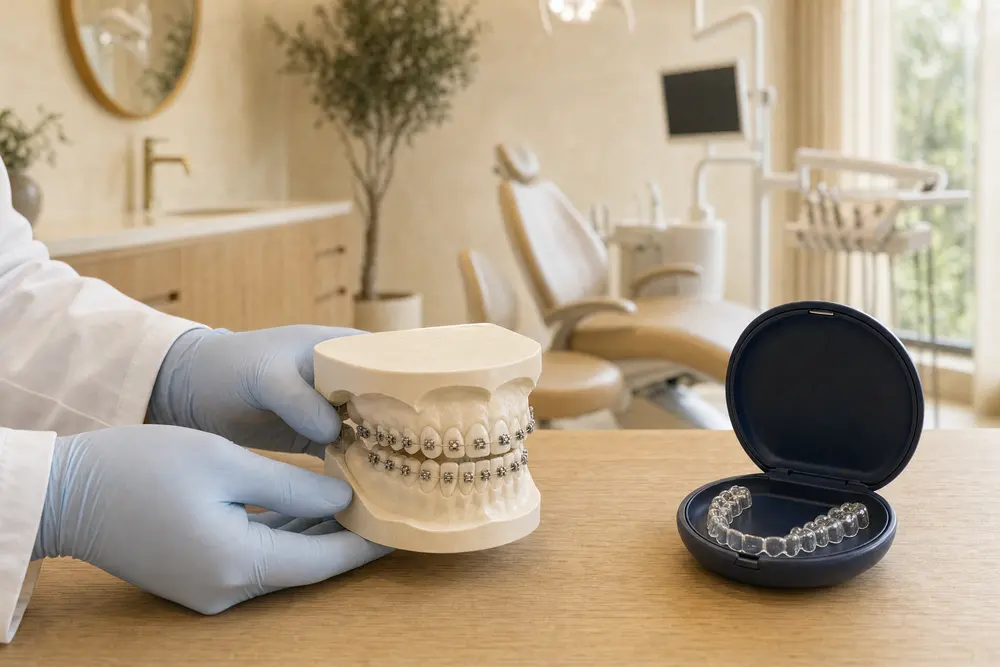
Clear removable trays that align teeth without brackets, changed every one to two weeks.
- Where
- First floor, Potta, on NH 544
Get directions - Open
- Every day, 10 am – 7 pm
- Who treats you
- Dr. Pavya Priya · KDC 28861
- Fees
- 1 fee range
See all fees
On this page
Clear aligners are thin, see-through plastic trays that fit over the teeth and move them a small step at a time. At Kallada Smile, aligner cases are planned by Dr. Pavya Priya, an orthodontist.
What it is
You wear a set of trays in order. Each one is shaped slightly differently from the last, so the teeth follow the plan tray by tray. Most people change to the next tray every one to two weeks.
The trays are made from a scan or from impressions taken at the clinic. Dr. Pavya sets the sequence of movements first; the laboratory then makes the trays to that plan.
Small tooth-coloured bumps, called attachments, are sometimes bonded to a few teeth. They give the tray something to push against. They come off at the end.
Signs you might need it
- Teeth that overlap or twist, where the crowding is mild or moderate.
- Small gaps between the front teeth.
- Teeth that have drifted after an earlier course of braces.
- A bite that needs correcting, where Dr. Pavya judges aligners can do the work.
- You would rather not have brackets showing at work or at college.
Aligners do not suit every case. Braces are often the better plan for large movements, and for teeth rotated a long way. The same is true where teeth must be removed to make room. Dr. Pavya says which applies to you after records.
What happens at Kallada Smile
Consultation. Dr. Pavya examines your teeth, your gums and your bite, and listens to what bothers you.
Records. Photographs, X-rays and a scan or impressions. X-rays are not taken at Kallada Smile: the clinic does not hold a radiation licence yet. Where one is needed you are given a written note and sent to a radiology centre in Chalakudy, about five minutes away by road, which charges you separately. The picture is read and explained at your appointment.
Plan and fee. You get a written plan showing what will move and how many trays are likely. It also gives the likely length and the full fee range. You decide.
Fitting. Attachments are bonded if the plan needs them, and the first tray is fitted and checked. You are shown how to take the trays in and out.
Reviews. Every 6 to 8 weeks Dr. Pavya checks that the teeth are tracking the plan and hands over the next few trays.
Refinements and retainers. Near the end, extra trays are usually made to finish the detail. Retainers follow, and they are not optional.
Options
Aligners for the whole course. The usual arrangement: every movement is planned in trays from start to finish.
Aligners for one jaw. Sometimes enough when only the upper or lower front teeth have drifted. The bite still has to work at the end, so this is not always possible.
Braces instead. For crowding that needs a lot of movement, or where teeth must be removed, fixed braces are often the more predictable route.
Braces first, aligners after. Occasionally the two are combined. Dr. Pavya will say if your case is one of them.
The system affects the fee more than it affects the plan.
What can go wrong
Aligner treatment usually needs a little enamel filed from between the teeth to make room. That is called interproximal reduction; it is measured in fractions of a millimetre, and it cannot be undone. The roots shorten a little in most cases, as they do with braces, and in a small number enough to matter. Small tooth-coloured attachments are bonded to the teeth and can leave a mark where brushing slips. Aligners only work while they are in the mouth, so a case that is not worn for the hours set does not finish on plan. Teeth drift back without retainers.
How long it takes and how many visits
Most aligner courses take 6 to 24 months. A few front teeth take the least time. A full correction of the bite takes the longest.
You come in every 6 to 8 weeks, which is roughly 6 to 10 visits across the course. The visits are short, about 15 to 20 minutes.
The single thing that changes the timeline most is wear time. Trays left out of the mouth do not move teeth, and the plan then has to be redone. Dr. Pavya gives a likely range only after records.
Looking after it afterwards
- Wear each tray for at least 20 to 22 hours a day, taking it out only for meals and brushing.
- Rinse the tray in cool water, never hot, and brush it gently. Hot water distorts the plastic.
- Brush your teeth before putting a tray back in. Sugar trapped under a tray sits against the enamel for hours.
- Keep the previous tray until the next review, in case the new one splits.
- Store trays in the case, not in a napkin. Most lost trays go out with the rubbish.
- Wear the retainers as Dr. Pavya sets out once the course is over. Teeth drift back without them.
Fees
- Clear aligners₹65,000 – ₹2,00,000
The final fee is confirmed after examination, in writing, before treatment starts. See all fees
Questions about clear aligners
How many hours a day must aligners be worn?
At least 20 to 22 hours a day, every day. They come out only for meals, for hot drinks and for brushing. Aligners move teeth by being worn, so an hour lost is not made up later. If you know you cannot manage that, say so at the consultation, because braces may suit you better.
What happens if an aligner is lost or cracked?
Message us the same working day and go back to the previous tray so the teeth do not drift. Dr. Pavya decides whether to reorder that tray or move you on to the next one. A replacement tray is charged separately; ask us for the fee and the wait when you start.
Can I eat and drink with aligners in?
No. Take them out for anything except plain water. Food traps under the tray, and hot drinks can distort the plastic. Coffee, tea and turmeric will also stain the tray. Rinse the aligners and brush your teeth before putting them back in.
Do clear aligners work as well as braces?
For mild and moderate crowding and spacing, they can do the same job when worn as instructed. Cases that need large movements, teeth rotated a long way, or teeth removed to make room, are often planned with braces instead. Dr. Pavya says which suits your case after records, and why.
What are refinements?
Extra aligners made near the end of a course, once Dr. Pavya sees which teeth have not moved exactly as planned. Most cases need at least one round. Ask at the consultation whether refinements are included in the fee or charged separately.
Care for every smile
Ready when you are.
Tell us your name and what is bothering you. We reply with a time.