
Get directions
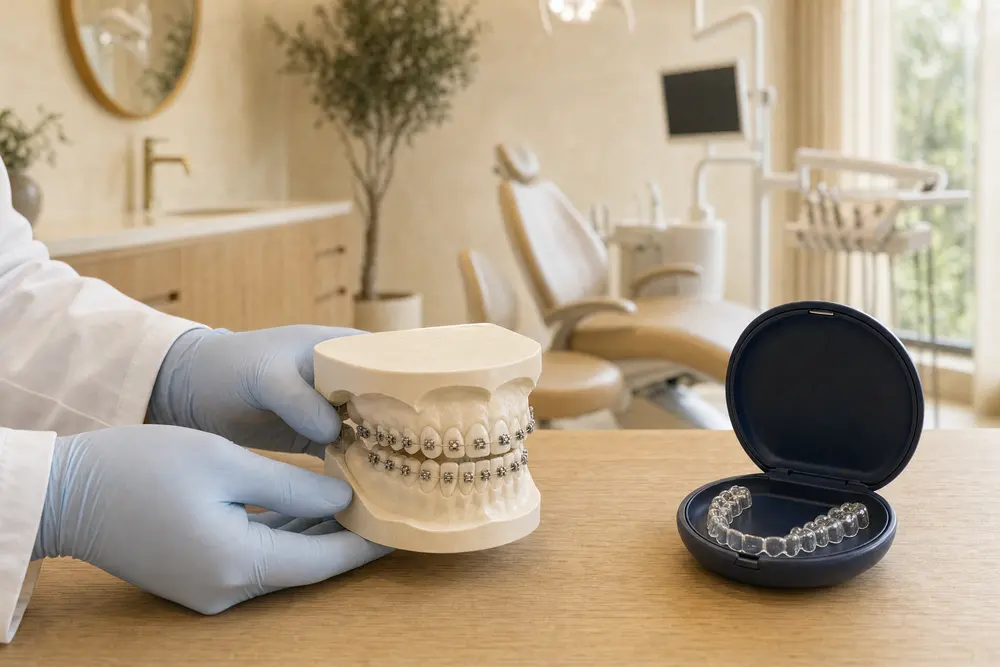
Retainers
Worn after the braces come off, so the teeth stay where they were moved to.
- Where
- First floor, Potta, on NH 544
Get directions - Open
- Every day, 10 am – 7 pm
- Who treats you
- Dr. Pavya Priya · KDC 28861
- Fees
- 1 fee range
See all fees
On this page
A retainer holds teeth in the position that treatment put them in. It is not an optional extra at the end of braces; it is the part that makes the rest last. At Kallada Smile, retainers are made and fitted by Dr. Pavya Priya, an orthodontist.
What it is
Teeth sit in bone, held by fibres that stretch when a tooth is moved. Those fibres take months to settle, and they pull the tooth back meanwhile. A retainer resists that pull while the bone and the fibres reorganise.
After the settling period, teeth still drift slowly through life. Jaws change shape with age, and the lower front teeth crowd in most people whether or not they ever had braces. That is why retainer wear does not stop at a date.
Signs you might need it
- Your braces are coming off, or your last aligner is finished.
- Your retainer has been lost, cracked or left somewhere on a journey.
- The retainer has started to feel tight, which means the teeth have already begun to move.
- A fixed wire behind your front teeth has come unstuck at one end.
- Your teeth have drifted since a course of braces years ago.
- You have stopped wearing a retainer and want to know whether it is too late to restart.
Bring the old retainer with you, even if it is broken. It tells Dr. Pavya where the teeth used to be.
What happens at Kallada Smile
Examination. Dr. Pavya checks the teeth, the bite and the gums, and looks at any retainer you already have.
Impression or scan. The teeth are cleaned first, and any bonding material left from braces is polished away. The impression takes a few minutes.
Making. A removable retainer is made in the laboratory to that shape. A fixed retainer is bonded at the same visit or the next one.
Fitting. The retainer is seated, checked for pressure points and adjusted. You are shown how to put it in, take it out and clean it.
Review. A short visit a few weeks later confirms it is still seating properly and that nothing has moved.
Options
Removable clear retainer. A thin transparent tray over the teeth, made from a scan or an impression. Hard to notice in wear, easy to clean, and easy to lose. It wears out and needs replacing; how often depends on the retainer and on how you use it.
Removable wire retainer. An acrylic plate with a wire across the front teeth. Sturdier and longer lasting than a clear tray, and more noticeable. It can be adjusted.
Fixed retainer. A thin wire bonded to the back of the front teeth. It works without you remembering anything, which is its main advantage. It needs careful cleaning and an occasional repair.
Both. Common after braces: a fixed wire behind the front teeth and a removable retainer worn at night over everything.
Dr. Pavya says which suits your case and why. You decide.
What can go wrong
A retainer holds a result; it does not create one. Teeth drift back as soon as one stops being worn, and how far they drift is not predictable. A fixed retainer is a thin wire bonded behind the teeth, and plaque builds around it, so it needs cleaning between the teeth every day and checking at every visit; a wire that comes unbonded at one tooth can let that tooth move without you noticing. A removable retainer wears out, cracks and is lost, and it stops working the moment it does not fit.
How long it takes and how many visits
Taking the impression or scan takes about 15 minutes. The retainer is made after that, and fitting takes another short visit.
A fixed retainer is bonded in one appointment of about 30 to 45 minutes.
Wear is the long part. Expect full-time wear at first, then nights, and then nights indefinitely. Dr. Pavya writes the schedule down for you rather than leaving it to memory.
Looking after it afterwards
- Wear it on the schedule you were given. Missing a few nights is recoverable; missing months usually is not.
- Rinse a removable retainer in cool water and brush it gently with soap, not toothpaste. Toothpaste scratches the plastic and hot water distorts it.
- Keep it in its case whenever it is out of your mouth. Retainers wrapped in a napkin end up in the bin.
- Keep it away from dogs, small children and hot vehicles.
- Clean around a fixed wire every day with a floss threader or an interdental brush. Have it checked at each routine visit.
- If a retainer cracks, will not seat, or feels tight, message us within a day or two rather than leaving it.
Fees
- Retainers, per set₹3,000 – ₹8,000
The final fee is confirmed after examination, in writing, before treatment starts. See all fees
Questions about retainers
How soon must a lost retainer be replaced?
Within days, not weeks. Teeth begin to drift as soon as nothing is holding them. The drift is fastest in the first months after braces come off. Message us the day you notice it is gone. If you still have an older retainer, wear that one meanwhile, even if it feels tight.
How long are retainers worn?
Full time at first, then at night. After that, at night for as long as you want the teeth to stay where they are. Teeth move throughout life, with or without braces. A retainer is not a course that finishes; it is what holds the result.
Can a retainer bring teeth back if they have already drifted?
A little, if the drift is small and recent, and if the old retainer still seats without force. Never force one on. If it does not go in easily, stop and message us, because a forced retainer can push a tooth the wrong way. Larger drift needs a short course of treatment instead.
Does a fixed retainer cause tartar?
It can, because the wire sits where a toothbrush does not reach easily. Floss threaders or an interdental brush deal with it, and a cleaning appointment every 6 to 12 months keeps it in check. Dr. Pavya shows you the technique on the day the wire is bonded.
Can I get retainers here if my braces were done elsewhere?
Yes. Bring any retainer you still have, and the name of the clinic that treated you if you remember it. Dr. Pavya examines the teeth and the bite first. A retainer is made to hold a position, and she has to see that the position is stable.
Care for every smile
Ready when you are.
Tell us your name and what is bothering you. We reply with a time.