
Get directions
Orthodontics for adults
Braces or aligners at any age, once the gums and bone are healthy enough.
- Where
- First floor, Potta, on NH 544
Get directions - Open
- Every day, 10 am – 7 pm
- Who treats you
- Dr. Pavya Priya · KDC 28861
- Fees
- 2 fee ranges
See all fees
On this page
Teeth can be moved at any age. What changes with age is not whether it works, but what has to be checked first. At Kallada Smile, adult cases are planned and carried out by Dr. Pavya Priya, an orthodontist.
What it is
Braces and aligners work the same way in an adult as in a teenager. A gentle force is applied, the bone around the root remodels, and the tooth moves.
Adult bone is denser and the tissue turns over more slowly, so the same movement often takes a little longer. The plan allows for that rather than pushing harder.
Adults also arrive with more history in the mouth: fillings, crowns, missing teeth, gums that have receded. All of it shapes what is possible, which is why records matter more here than at any other age.
Signs you might need it
- Front teeth that have crowded or overlapped over the years.
- Gaps that opened after a tooth was removed and never replaced.
- Teeth that drifted back after a course of braces in your teens.
- A bite that has worn the front teeth flat, or chipped their edges.
- Food packing into the same spot between two teeth every day.
- One tooth taking the whole force of the bite and aching.
- Teeth that must be lined up before crowns, a bridge or an implant can be planned.
None of these means you must have treatment. A consultation tells you what is happening and what the choices are.
What happens at Kallada Smile
Consultation. Dr. Pavya examines your teeth, gums, bite and jaw joints, and asks what bothers you and what you want changed.
Gums first. Bleeding gums, tartar or bone loss are treated and stable before any tooth is moved. This may mean a cleaning course, and a wait of a few weeks. It is not a delay that can be skipped.
Records. Photographs, impressions or a scan, and X-rays including a full view of the jaws. X-rays are not taken at Kallada Smile: the clinic does not hold a radiation licence yet. Where one is needed you are given a written note and sent to a radiology centre in Chalakudy, about five minutes away by road, which charges you separately. The picture is read and explained at your appointment.
Plan and fee. A written plan: what will move, what will not, and whether any tooth needs removing. It also gives the likely length and the full fee range for each option. You decide.
Treatment. Braces are fitted, or the first aligner tray is issued. Visits every 4 to 8 weeks, with a gum check each time.
Retainers. Fitted the day the braces come off, or as the last aligner is finished.
Options
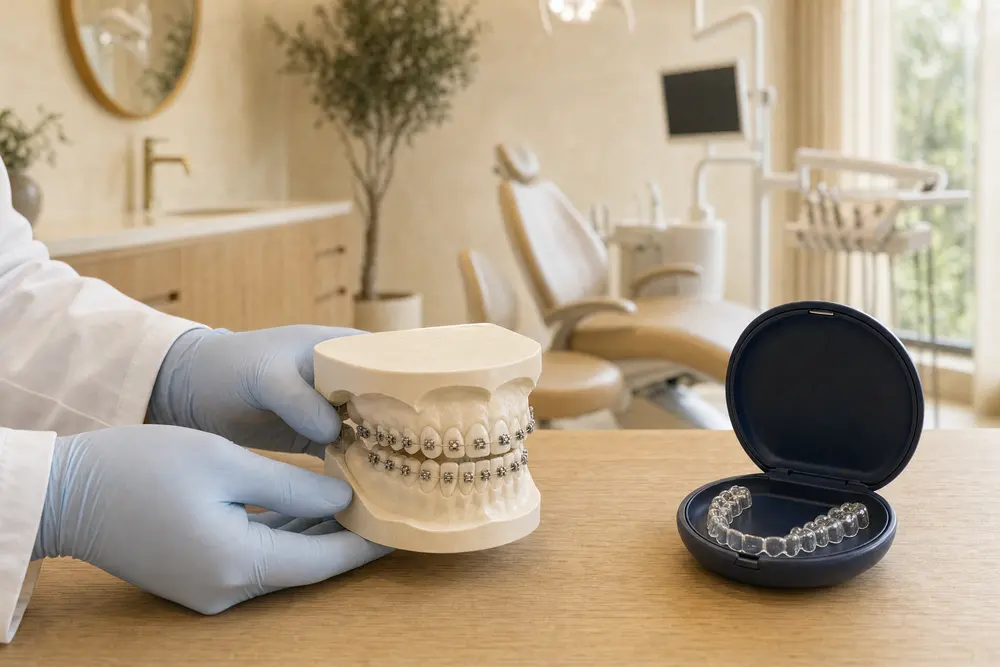
Ceramic braces. Tooth-coloured brackets, the usual choice for adults who want fixed braces that show less. They cost more than metal and can stain around the ties with tea, coffee or turmeric.
Clear aligners. Removable trays worn 20 to 22 hours a day. They suit mild and moderate cases and depend entirely on being worn.
Metal braces. Still the most predictable for large movements, and the option that costs least.
Limited treatment. Moving only the front teeth, where that is all you want changed and the bite allows it. Shorter and cheaper, but it does not correct a bite.
Treatment alongside other dentistry. Where crowns, a bridge or an implant are planned, orthodontics may come first. The teeth are then in the right place for them.
What can go wrong
Moving adult teeth carries the same risks as moving a teenager’s, and a few that matter more. The roots shorten a little in most cases, and in a small number enough to matter. Enamel around a bracket can be left with a white mark where brushing slips. Gums that have already receded can recede further, and a tooth that was knocked or heavily filled years ago can lose its nerve during treatment. Where gum disease is present it is treated first, because moving teeth in inflamed bone makes the bone loss worse. Teeth drift back without retainers, and adult teeth drift for life.
How long it takes and how many visits
Most adult courses run 12 to 30 months. Limited front-teeth cases take less. Cases that correct a bite, or that need teeth removed, take longer.
Visits are every 4 to 8 weeks, about 12 to 20 over the course, and each takes 20 to 30 minutes.
Dr. Pavya gives a likely range after records and will not promise a finish date before then. Missed visits and unworn aligners add months, and are one of the commonest reasons a case runs over.
Looking after it afterwards
- Clean around every bracket after meals, and use whatever interdental aid Dr. Pavya shows you. Adult gums punish poor cleaning faster than young ones do.
- Keep the gum appointments during treatment, not only the adjustment ones.
- Expect aching for two or three days after fitting and after each adjustment.
- Avoid hard and sticky food while brackets are on: ice, chikki, hard murukku, sugarcane.
- Wear the retainers exactly as instructed, and keep wearing them at night for as long as Dr. Pavya sets out.
- Come back if a retainer cracks, is lost, or starts to feel tight. A tight retainer means the teeth have already begun to move.
Fees
- Metal braces, full course₹35,000 – ₹55,000
- Clear aligners₹65,000 – ₹2,00,000
The final fee is confirmed after examination, in writing, before treatment starts. See all fees
Questions about orthodontics for adults
Will braces harm the gums in an adult?
Not if the gums are healthy when treatment starts and stay clean during it. Moving teeth through bone that is already inflamed can make gum disease worse. That is why the gums are treated first and checked at every visit. Cleaning around brackets takes longer than cleaning normal teeth.
Can teeth be moved if I already have a crown or a bridge?
Often yes. Brackets can be bonded to a crown, though the bond is less reliable than it is on enamel. A bridge joins two teeth together, so those teeth cannot move separately and the plan has to work around them. Dr. Pavya checks what is in your mouth before quoting.
Do adults have to wear retainers for longer?
Retainers are for life in every age group, but adults tend to be told to keep to a night-time schedule more strictly. The bone around an adult tooth settles more slowly after the tooth is moved.
What are the choices for an adult who would rather brackets did not show?
Ceramic braces, which are tooth-coloured, and clear aligners are the two usual routes. Ceramic brackets are still visible up close. Aligners come out for meals and photographs, but only work if they are worn 20 to 22 hours a day. Dr. Pavya explains what each will and will not do for your case.
My teeth moved again years after braces. Can they be corrected?
Usually. Teeth drift through life, and drift after braces is common when retainers were stopped. A second course is often shorter than the first because the movement needed is smaller. Records come first, because the gums and the bone have to be checked before anything is moved.
Care for every smile
Ready when you are.
Tell us your name and what is bothering you. We reply with a time.