
Get directions
Dentures
Removable teeth, partial or full, made and fitted over a few visits.
You may know this as veppu pallu.
- Where
- First floor, Potta, on NH 544
Get directions - Open
- Every day, 10 am – 7 pm
- Who treats you
- Dr. Pavya Priya · KDC 28861
- Fees
- 1 fee range
See all fees
On this page
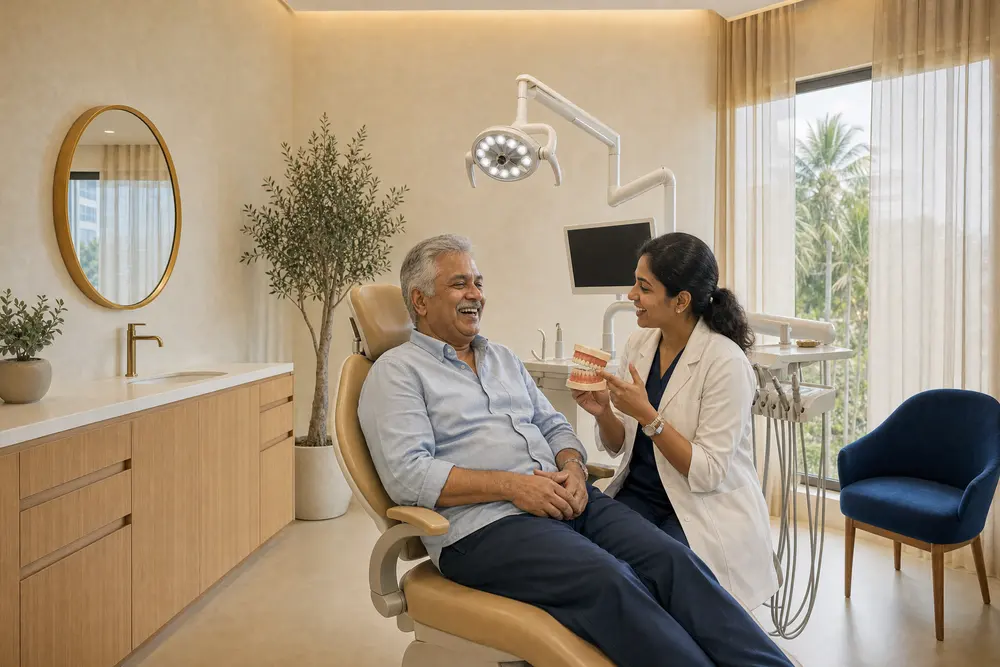
A denture is a removable set of false teeth on a plate that rests on the gum. It replaces teeth that have been lost, so you can chew and speak. At Kallada Smile dentures are planned and fitted by Dr. Pavya Priya, a registered dentist.
You may know these as veppu pallu (set teeth).
What it is
A denture rests on the gum and the bone underneath. A full denture replaces all the teeth in one jaw. A partial denture fills the gaps and clips onto the teeth that are left.
An upper full denture holds by suction across the palate. A lower one has less surface to hold on to. It is held mostly by the shape of the ridge, and by the tongue and cheeks. That is why lower dentures take more getting used to.
A denture is not made in one appointment. Impressions, a bite record and a wax try-in each come first. Problems are then found in wax rather than in the finished plate.
Signs you might need it
- Several teeth missing in the same jaw, so chewing has moved to one side.
- All the teeth in a jaw gone, or about to be removed.
- A gap where a bridge is not possible because the neighbouring teeth are not sound.
- Front teeth missing, so speech has changed or you avoid smiling.
- An old denture that no longer stays in place, or that rubs.
- A denture that has cracked, or that has lost a tooth from the plate.
Missing back teeth matter even when nobody sees them. The remaining teeth take the whole load and wear faster.
What happens at Kallada Smile
Examination. Dr. Pavya checks the remaining teeth, the gums and the ridges, and an X-ray is arranged where a buried root is possible. X-rays are not taken at Kallada Smile: the clinic does not hold a radiation licence yet. Where one is needed you are given a written note and sent to a radiology centre in Chalakudy, about five minutes away by road, which charges you separately. The picture is read and explained at your appointment.
The plan and the fee. Partial or full, which material, how many visits, and the fee range, in writing. Any removals or fillings needed first are listed separately. You decide.
Impressions. A first impression of each jaw, then usually a second, more accurate one taken in a tray made to your own shape.
Bite record. Wax blocks are used to record how the jaws meet and how high the teeth should sit.
Try-in. The teeth are set in wax and tried in your mouth. You check the look, the shade and your speech, and family can look too. Changes are easy at this stage and hard afterwards.
Fitting. The finished denture is inserted and adjusted. You are shown how to put it in, take it out and clean it.
Adjustments. Sore spots are eased at short visits in the first weeks. Almost everyone needs at least one.
Options
Partial denture in acrylic. A pink plastic plate with teeth set into it and wire clasps. The usual first choice, and the one that costs least. It can have teeth added later if more are lost.
Partial denture with a metal frame. A thin cast framework, stronger and less bulky than acrylic, with better support from the remaining teeth. It costs more and cannot be added to as easily.
Full denture. One jaw or both, made in acrylic.
Immediate denture. Fitted on the day the last teeth are removed, so you are not without teeth. It needs relining as the gum heals.
Flexible denture. A softer material with no metal clasps.
Bridge instead. Fixed, not removable, where the neighbouring teeth are sound enough to carry it.
Implants instead. Kallada Smile does not place implants yet. Where implants are the better route, we examine you and refer you.
What can go wrong
A new denture is uncomfortable at first. It rubs sore spots that have to be eased at review visits, speech takes days to a few weeks to settle, and eating has to be relearned on both sides at once. The ridge of bone under a denture keeps shrinking after the teeth are gone, so a denture that fits today becomes loose over the years and needs relining or remaking. A lower full denture is the hardest of all to keep still. A partial denture puts load on the teeth that hold its clasps and traps plaque against them, so those teeth need more cleaning, not less. A flexible denture with no metal is difficult to reline or add to later.
How long it takes and how many visits
Expect 3 to 5 visits, about a week apart, so 3 to 6 weeks from the first impression to the fitting.
Each visit is short, 20 to 40 minutes, except the try-in, which takes longer because it is the visit where decisions are made.
Where teeth have to be removed first, the gum is usually left to heal before the impressions are taken. The exception is an immediate denture.
Add two or three adjustment visits in the weeks after fitting. They are part of the treatment, not a sign that something went wrong.
Looking after it afterwards
- Practise with soft food cut small, chewing on both sides at once. Speech settles within one to two weeks; eating takes longer.
- Take the denture out at night. Clean it and keep it in water or the solution you were given, never in hot water.
- Clean it over a basin of water or a folded towel. Most dentures break when they are dropped on a hard floor.
- Brush the denture with soap and a denture brush, not toothpaste, which scratches the surface.
- Brush your gums, tongue and any remaining teeth morning and night, with the denture out.
- Come in for a sore spot rather than trimming the denture yourself. One or two minutes with the right instrument fixes it.
- Have the fit checked once a year. Gums change shape, and a relining costs far less than a new denture.
Fees
- Dentures₹8,000 – ₹45,000
The final fee is confirmed after examination, in writing, before treatment starts. See all fees
Questions about dentures
How long does it take to get used to a new denture?
Speech usually settles within one to two weeks, and eating takes longer, often four to six weeks. Sore spots in the first days are expected and are eased at an adjustment visit. Nearly everyone needs at least one adjustment, so book it rather than putting up with a rub.
Can a denture be fitted immediately after teeth are removed?
It can, and it is called an immediate denture. It saves you from being without teeth. The gum shrinks as it heals underneath, so it will need relining or replacing within some months. Dr. Pavya explains that extra cost before you choose it.
Should dentures be taken out at night?
Usually yes. The gum needs hours without pressure, and leaving a denture in overnight makes sore, red tissue and fungal infection more likely. Take it out, clean it, and keep it in water or the cleaning solution you were given.
Why has a denture that fitted well become loose?
The bone under the gum slowly shrinks once teeth are gone, and the denture stays the same shape. This is normal and it is why dentures are relined every few years rather than replaced. A denture that has become loose quickly should be checked sooner.
Can a cracked or broken denture be repaired?
Often yes, and quickly, if you bring every piece and have not glued them. Household glue makes a repair harder and is not safe in the mouth. Where the break is through a thin worn section, a repair may only hold for a while. A new denture is then the honest answer.
Care for every smile
Ready when you are.
Tell us your name and what is bothering you. We reply with a time.