
Get directions
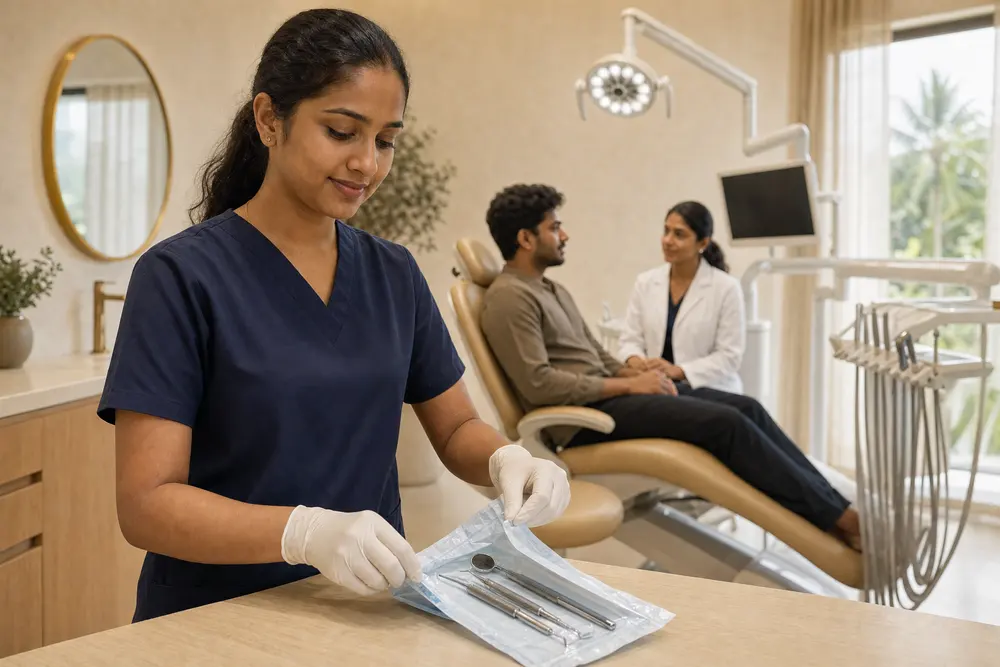
Tooth extraction
Removing a tooth that cannot be saved, including wisdom teeth that are stuck.
- Where
- First floor, Potta, on NH 544
Get directions - Open
- Every day, 10 am – 7 pm
- Who treats you
- Dr. Pavya Priya · KDC 28861
- Fees
- 2 fee ranges
See all fees
On this page
Removing a tooth (extraction) is the last option, not the first. A tooth is taken out when it cannot be repaired, or when keeping it would cost you more than losing it. At Kallada Smile, teeth are removed by Dr. Pavya Priya, a registered dentist.
What it is
A tooth sits in a socket of bone, held by fibres. Numbing removes the feeling, an instrument widens the socket and stretches those fibres, and the tooth comes out. You should feel firm pressure and hear noise rather than pain. Tell us the moment you feel anything sharp: we stop and add more anaesthetic.
A simple extraction is one where the tooth is visible and can be gripped. A surgical extraction is one where the tooth is broken at the gum line, or buried in bone. The gum is opened and the tooth is taken out in pieces.
Wisdom teeth are one of the commonest surgical cases, because they arrive last and often have no room.
Signs you might need it
- A tooth broken so far down that nothing is left to build on.
- Decay that has destroyed the tooth below the gum line.
- A root canal that has failed and cannot be redone.
- Advanced gum disease that has loosened the tooth in its socket.
- A wisdom tooth that keeps swelling, or that is decaying the tooth in front of it.
- A milk tooth that has not fallen out while the adult tooth is coming in beside it.
- A tooth that has to go to make room, as part of a plan for braces.
Removal is a decision, and in most cases there is time to make it. Dr. Pavya explains what keeping the tooth would involve and what it would cost. You decide.
What happens at Kallada Smile
Examination and X-ray. Dr. Pavya checks the tooth, and an X-ray is needed to see the roots, their shape, and what sits near them. X-rays are not taken at Kallada Smile: the clinic does not hold a radiation licence yet. Where one is needed you are given a written note and sent to a radiology centre in Chalakudy, about five minutes away by road, which charges you separately. The picture is read and explained at your appointment.
Medical history. Tell us about diabetes, heart conditions, pregnancy and every medicine you take, including anything bought without a prescription. Blood thinners, and the bone medicines given for osteoporosis or with cancer treatment, matter most. It changes the plan, and occasionally it means the removal is better done elsewhere.
The plan and the fee. Simple or surgical, one visit or two, and the fee range, in writing before anything starts.
Numbing. An injection, then a wait until the area is fully numb. Nothing begins before that.
The removal. For a simple case, the tooth is loosened and lifted out. For a surgical case, the gum is opened, the tooth is divided and removed in pieces, and the gum is stitched.
Afterwards. You bite on a gauze pack for an hour, and leave with written aftercare and a number to message if anything worries you.
Options
Simple extraction. One visit, local anaesthetic, no cut and no stitches.
Surgical extraction. For a broken or buried tooth. A small cut, sometimes a little bone removed, and stitches. Whether they dissolve on their own or are taken out at a review is said before the removal starts.
Wisdom tooth removal. Simple where the tooth has come through, surgical where it is angled or under the bone.
Referral. Deeply buried wisdom teeth, roots close to the nerve, and patients who need sedation are referred to an oral surgeon. Dr. Pavya tells you before you start if she thinks your case belongs there, and what it is likely to cost.
Keeping the tooth instead. A root canal and a crown will save many teeth that look beyond repair. The comparison, with both fee ranges, is given before you decide.
What can go wrong
Removing a tooth is a small operation. The clot in the socket can be lost, which is a dry socket: a deep ache that starts two to four days later and spreads to the ear. Bleeding can restart, and bruising, swelling and a jaw that will not open fully can follow a surgical case. A lower wisdom tooth can sit against the nerve that supplies the lip, the chin and the tongue, so removing it can leave numbness or an altered feeling there; it usually recovers over weeks or months, and in a small number of cases it does not. An upper back tooth sits close to the sinus, and the two can open into each other. A root tip is sometimes left in place on purpose, because removing it would do more harm than leaving it. Dr. Pavya says before you decide which of these applies to your tooth, and refers the cases that belong with an oral surgeon.
How long it takes and how many visits
A simple removal takes 15 to 30 minutes, including the numbing, in one visit.
A surgical removal takes 30 to 60 minutes, with a review at about a week if stitches were placed.
Where a tooth is infected and swollen, antibiotics may come first and the removal happens a few days later. That is not a delay for its own sake; a swollen area does not numb well.
Plan to go home quietly afterwards rather than back to work, especially after a surgical case.
Looking after it afterwards
- Bite firmly on the gauze for an hour. If bleeding restarts, bite on a clean rolled handkerchief for another half hour and message us if it does not stop.
- No rinsing, spitting or hot drinks for the rest of the day. All three dislodge the clot that has to form.
- No smoking for at least 48 hours. Smoking is the single biggest thing that brings on a dry socket. Avoid rinsing hard, spitting and drinking through a straw for the rest of the day too, so the clot is not disturbed.
- Eat soft, cool food on the other side. Rice and curd, kanji, ice cream.
- From the next day, rinse gently with warm salt water two or three times a day, especially after eating.
- Take the medicine exactly as prescribed. A deep ache starting on day two to four, spreading to the ear, usually means a dry socket, though a spreading infection can feel much the same and is treated differently. Come in rather than increasing the painkillers.
- Swelling peaks at about 48 hours after a surgical case, then settles. Cold on the cheek for the first day helps.
Fees
- Removing a tooth, simple₹500 – ₹1,500
- Wisdom tooth removal₹3,000 – ₹8,000
The final fee is confirmed after examination, in writing, before treatment starts. See all fees
Questions about tooth extraction
Do all wisdom teeth have to be removed?
No. A wisdom tooth that has come through in a good position, bites against its partner and can be cleaned is left alone. Removal is considered when it keeps getting infected, when it decays, or when it damages the tooth in front. It is also considered when the tooth is stuck in the bone and causing trouble.
What is a dry socket?
The blood clot that fills the socket is lost or breaks down before the gum heals, leaving bone exposed. It usually starts two to four days after the removal. The pain is a deep ache that spreads to the ear, and ordinary painkillers do not help much. It is treated with a dressing in the socket. Come in rather than waiting it out.
How long does the socket take to heal?
The gum closes over in about one to two weeks, and the bone underneath fills in over some months. Most people are back to normal eating within a few days for a simple removal. Allow about a week for a surgical one.
Can a tooth be removed while it is infected?
Often yes, and removing the tooth is what drains the infection. Where the swelling is spreading, or the tooth cannot be numbed properly, antibiotics come first. The tooth is removed a few days later. Dr. Pavya decides on the day.
Does the gap have to be filled afterwards?
Not always, but a gap changes things. The teeth on either side tilt into it and the opposite tooth grows down, over years. A back gap that no one sees may still need replacing for that reason. Dr. Pavya explains the choices, including where we would refer you to a specialist, and you decide.
Care for every smile
Ready when you are.
Tell us your name and what is bothering you. We reply with a time.